 How-to
How to Lose Weight Without Calorie Counting
Last Updated: November 10, 2026
Quick Summary
You can lose weight without calorie counting by building meals around whole foods, protein, vegetables, fiber, and healthy fats, and by eating on a steady rhythm. A 2018 JAMA study found people who ate less highly processed food lost more weight than peers who counted calories. Manage portions with hunger cues and non-scale markers instead of an app.
- Fill half your plate with vegetables and fruit, a quarter with protein, and a quarter with whole grains.
- Rate hunger from 1 to 10 and aim to start meals at 3 or 4 and stop at 6 or 7.
- Weigh yourself at most once a week and treat it as one data point among many.
- Give any new way of eating at least four to six weeks before judging it.
- A true plateau is six weeks or more without change despite consistent effort.
Table of Contents
- Why You Can Lose Weight Without Counting Calories
- Building Balanced Meals for Weight Loss
- Portion Control Without Measuring: Reading Hunger and Satiety Cues
- Weight Loss Meal Ideas That Keep You Full
- How to Monitor Progress Without Tracking Every Bite
- How Long to Lose Weight Without Calorie Counting
- What to Do When Weight Loss Stalls
- Schedule a Consultation with Pamela
- Frequently Asked Questions
Why You Can Lose Weight Without Counting Calories
You can lose weight without calorie counting because food quality and meal structure shape hunger, satiety, and how much you eat far more than a number in an app does. At Nutrition is Fashionable, we teach women to build meals around whole foods and steady eating rhythms instead of arithmetic. A 2018 JAMA study, summarized by Optum's guide to losing weight without counting calories, found that people who ate less highly processed food lost more weight than peers who counted calories.
That does not mean calories are irrelevant. Energy balance still matters. It means you can manage energy balance through better food choices rather than through tracking.
What the Research Says About Tracking and Food Quality
Tracking is not the magic ingredient. Researchers publishing in the Journal of the Academy of Nutrition and Dietetics study on dietary tracking adherence found that people who tracked inconsistently lost about the same amount of weight as those who rarely tracked at all.
So what does move the needle?
- Diet quality. Minimally processed foods keep you fuller on less.
- Meal structure. Regular meals steady your appetite.
- Food swaps. Small replacements add up without a spreadsheet.
A review in research on optimal diet strategies for weight loss and maintenance describes calorie deficits of 500 to 750 per day as a common approach in the literature. Here is the point most guides miss: you can create that gap through portion habits and food choices without ever logging a meal.
Building Balanced Meals for Weight Loss
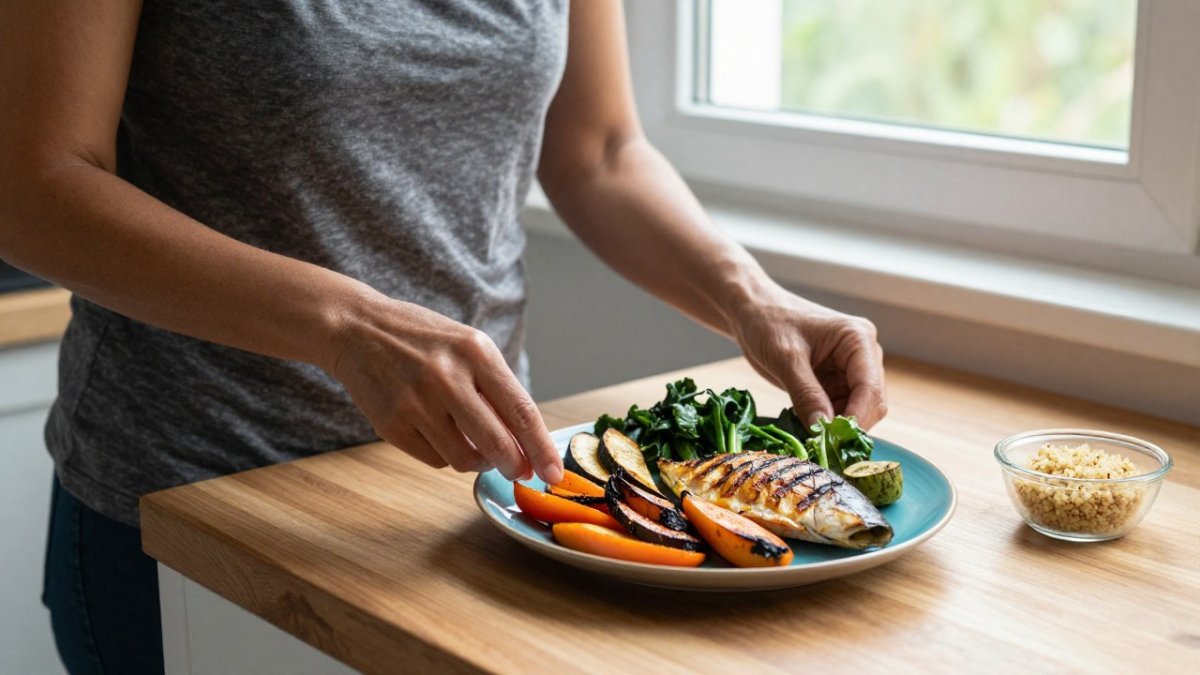
Balanced meals for weight loss combine a protein source, plenty of vegetables, a fiber-rich carbohydrate, and a source of healthy fats. This mix slows digestion, steadies energy, and keeps hunger quiet for hours. For women over 40, that steadiness can matter even more during hormonal changes.
Our approach at Nutrition is Fashionable starts with bio-individuality. There is no single plate that fits every woman. What works for your neighbor's gut may not work for yours. You can read more about our coaching philosophy if you want the full picture.
A Simple Plate Structure to Follow at Every Meal
Fill half your plate with vegetables and fruit. Give a quarter to protein: eggs, fish, chicken, or pressure cooked beans, or fermented tempeh. Use the last quarter for whole grains or starchy vegetables. Add a thumb-sized portion of healthy fats like olive oil, avocado, or nuts.
That is the whole framework. No scale, no app.
- Breakfast: eggs with sautéed greens, sauerkraut and sweet potato bread
- Lunch: large salad with tuna, olive oil, and lemon
- Dinner: grilled chicken, roasted root vegetables, and a small scoop of riced cauliflower
Portion Control Without Measuring: Reading Hunger and Satiety Cues
Portion control without measuring works by tuning into hunger and fullness signals instead of external numbers. Your body gives you feedback at every meal. Most of us have just learned to ignore it.
Try this: rate your hunger from 1 to 10 before you eat. Aim to start meals at 3 or 4 and stop at 6 or 7. Use smaller plates. Serve once, then wait ten minutes before considering seconds. That pause is usually enough for satiety to catch up.
Watch out: eating fast overrides these cues entirely. Slow down and put your fork down between bites.
Weight Loss Meal Ideas That Keep You Full
Weight loss meal ideas work best when they combine protein, fiber, and healthy fats in the same meal. That trio slows digestion, steadies blood sugar, and keeps you full for hours without any need to weigh or log food. The goal is not a perfect recipe list but a repeatable pattern you can apply to whatever is in your kitchen.
A useful way to think about it: build each meal around a protein anchor, a fiber base, and a fat finisher. The protein anchor might be eggs, fish, chicken, beans, lentils, or plain Greek yogurt. The fiber base is vegetables, fruit, or a whole grain. The fat finisher is olive oil, avocado, nuts, or seeds.
Here are meal ideas we share with clients, organized by that pattern:
- Greek yogurt with berries, Basel seeds, and walnuts, protein anchor: yogurt; fiber base: berries and Basel seeds; fat finisher: walnuts.
- Lentil soup with a side of roasted vegetables, protein anchor: pressure cooked lentils; fiber base: vegetables; fat finisher: a drizzle of olive oil.
- Baked salmon with broccoli and baked sweet potato, protein anchor: salmon; fiber base: broccoli and reheated baked sweet potato; fat finisher: the salmon's own fats plus a little olive oil. Sauerkraut on the side.
- Scrambled eggs with arugula, mixed mushrooms(no button), and avocado, protein anchor: eggs; fiber base: arugula and mushrooms; fat finisher: avocado and sauerkraut.
- Chicken and vegetable stir-fry over cauliflower rice, protein anchor: chicken; fiber base: mixed vegetables; fat finisher: sesame oil or chopped walnuts/pecans or pistachios.
For grocery guidance, keep the pattern in mind rather than a rigid list. A simple weekly shop might include two or three protein anchors (eggs, fish, chicken, beans, yogurt), a few fiber bases (leafy greens, cruciferous vegetables, berries), and two or three fat finishers (olive oil, perilla oil avocado, nuts, seeds). That gives you enough variety to build meals without a spreadsheet.
Watch out: meal ideas only keep you full if you actually eat them. If your schedule is unpredictable, batch-cook one protein and one vegetable at the start of the week so the pattern is easy to follow on busy days.
If you want the foods, supplements, and kitchen tools we actually use and recommend, you can shop with Pamela for a curated list.
How to Monitor Progress Without Tracking Every Bite
Monitor progress with non-scale markers: how your clothes fit, your energy through the day, sleep quality, and steady strength gains. Weigh yourself at most once a week, same time, same conditions, and treat it as one data point among many.
Body weight fluctuates with hydration, hormones, and salt. A single high reading means little. Look at the trend across a month.
- Do your jeans button more easily?
- Is your afternoon energy steadier?
- Are you sleeping better?
- Can you walk or lift a little more than last month?
Here are the non-scale markers we use to judge progress instead of logging every bite.
Marker | What to look for | How often to check |
|---|---|---|
Clothes fit | Do your jeans button more easily? | Ongoing |
Energy | Is your afternoon energy steadier? | Ongoing |
Sleep quality | Are you sleeping better? | Ongoing |
Strength | Can you walk or lift a little more than last month? | Monthly |
Body weight | One data point among many; look at the trend | At most once a week |
How Long to Lose Weight Without Calorie Counting
Weight loss pace varies from person to person, and steady, gradual change is generally more sustainable than rapid loss. Faster loss usually means you cut too hard, and hard cuts tend to rebound.
For women in perimenopause or menopause, progress can be slower and less linear. Hormonal shifts affect appetite, sleep, and where your body stores fat. That is normal, not failure. Give any new way of eating at least four to six weeks before judging it. If you want a deeper look at steady, lasting change, read sustainable weight management for women.
What to Do When Weight Loss Stalls
Plateaus are normal, and they rarely mean you are doing something wrong. Weight loss is not linear. The body adapts to changes in food intake and activity, and progress often comes in waves rather than a steady line. A stall is a signal to troubleshoot, not a reason to panic or cut harder.
Work through this sequence before changing anything drastic:
- Check sleep and stress first. Poor sleep and high stress raise appetite hormones and make food choices harder. Consistent sleep and a daily walk can be helpful when progress stalls.
- Look for portion creep. Dressings, sauces, added sugar, and cooking oils hide in plain sight. Measure them for a week if you suspect they have crept up, then go back to eyeballing.
- Review protein and fiber at each meal. Many stalls resolve when every meal has a clear protein anchor and a fiber base. If you are hungry between meals, that is usually the missing piece.
- Check daily movement. A walk after meals helps more than most people expect. If your step count has dropped, that alone can explain a stall.
- Give it time. A true plateau is six weeks or more without change in weight, measurements, or clothing fit despite consistent effort. Anything shorter is usually normal fluctuation.
If the scale and your measurements have not moved for six weeks despite consistent effort, that is the moment to get personalized guidance. Individual needs vary, and medical conditions, medications, thyroid issues, and hormonal shifts can all play a role. Speak with your doctor about anything clinical, and consider working with a coach who can review your habits and adjust the plan to your life.
Watch out: the most common mistake at a plateau is cutting food intake further and further. That approach often backfires by increasing hunger and making the plan harder to sustain. Troubleshoot the basics first, then seek help if the stall persists.
Schedule a Consultation with Pamela
Changing how you eat without counting calories asks for patience and a plan built around your life. That is exactly what we do at Nutrition is Fashionable. Pamela is a Certified Holistic Health Coach and a graduate of the Institute for Integrative Nutrition, and has attended the Hippocrates Health Institute Life Transformation Program and the Optimum Health Institute program.
Our coaching gives you personalized meal guidance, an integrative view of nutrition and lifestyle factors, and support that fits a busy schedule. You can book a wellness coaching consultation or read more about Pamela before you decide.
If calorie counting has failed you before, the problem was likely the method, not you. We help you build balanced meals, read your hunger cues, and adjust as your body changes. Get started with Nutrition is Fashionable and build eating habits that hold up for the long term.
Frequently Asked Questions
Is it possible to lose weight without calorie counting?
Yes. Research summarized by Optum suggests that food quality can matter as much as calorie counting for weight loss. The key is that calories still matter for energy balance, but you can manage them through food quality, portion awareness, and meal structure rather than a tracking app. Focusing on whole foods, protein, fiber, and hydration naturally reduces intake without spreadsheets.
How can I lose weight without tracking what I eat?
Build meals around a plate structure: half vegetables, a quarter protein, and a quarter whole grains or healthy fats. Use portion control without measuring by serving on smaller plates and pausing to check hunger cues before seconds. Some research suggests a relaxed approach to tracking can still work for many people. Prioritize sleep, stress management, and daily movement too.
How long does it take to see results without calorie counting?
The timeline depends on your starting point, activity level, sleep, and stress. Calorie deficits are a basic principle of weight loss, and you can create a similar gap through food choices without counting. Consistency matters more than speed.
What should I eat to feel full and support weight loss?
Prioritize protein at every meal, fiber from vegetables, fruit, gluten free grains such as millet or sorghum and healthy fats like olive oil, perilla oil and avocado. These nutrients support satiety and steady energy. Reduce liquid calories from sugary drinks and swap refined snacks for whole foods. Drink water throughout the day. A practical weight loss meal idea is a large salad with grilled chicken, imported feta, olive oil dressing, and a side of berries (in season).